День: 01.11.2025

Head of a Girl

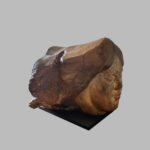
«Head of a Girl». 1914. Sergei Konenkov. Wood. Dimensions: 29×29×34.5 cm. Tactile model. Plastic. The sculpture depicts a young woman’s head with flowing hair streaming backward. The long hair, rendered as powerful, stylized strands, forms a dense mass that seems to elongate and stretch the sculptural form into depth. The girl’s face is slightly elongated, with features that are both prominent and flattened: wide-open eyes with heavy lids, a straight nose, and full lips. The description «semi-portrait, semi-allegory» fits this work well, though no specific mythological figure is named. Traces of the artist’s fascination with early Greek sculpture are discernible—the simplified volume of the facial area, the rather rough treatment of the wooden surface, and the avoidance of excessive detail. Yet if we compare this piece with the sculpture «Kore,» we find it less reminiscent of an archaic statue. by Irina Savenko

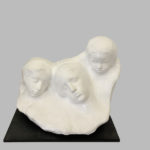
The Sleepers

«The Sleepers». 1912. Anna Golubkina. Marble. Dimensions: 49×71×40 cm. Tactile model. Plastic. The sculptural composition features three figures carved from white stone: the head of a young woman, the head of a mature woman, and the head of a child. The central figure is the mature woman (representing old age). The oval of her face has lost its definition, her head is slightly inclined to the left, and a deep fold marks her cheek. The right side of her face appears to «flow» downward in the direction of the tilt. Her large eyes are closed beneath their lids—she is asleep. Her nose is straight, and her lips are pressed together. To the left, the head of the young woman symbolizes youth. She leans to the right, toward the mature woman. Her hair flows freely, framing a regular, well-defined facial oval. The lids of her large eyes are closed. With a straight nose, clearly outlined mouth, and corners of the lips slightly upturned, she seems to smile in her sleep. To the right of the central figure, slightly elevated above it, is the carved head of a child—an image of early youth, childhood, and infancy. This forms the highest point of the composition. The baby’s head emerges most fully from the stone, positioned upright without any tilt. The face is round, with a small, convex forehead, a delicate, slightly upturned nose, plump cheeks, and a small mouth. Her eyes are open—unlike the others, she is not asleep. She appears to gaze attentively, with a curious expression. In «The Sleepers,» Golubkina explores the portrayal of a human being across different stages of life. The work unites three ages: youth, maturity, and old age. The artist succeeded in capturing in stone something seemingly devoid of plastic expression by its very nature—the passage of time. At first glance, the sculpture resembles a single block of white marble. The natural qualities of the stone emphasize an almost imperceptible temporal plasticity: from a neutral, «natural» background—as if from the very element of time—human faces emerge, poised to vanish again, to dissolve back into the stone. Only the facial features are elaborately detailed—the smooth, polished marble seems to convey the shimmer of living skin. Shoulders, hair, and necks merge with the rough, untreated surface, as if these three images are emerging before us from the foam of time. by Irina Savenko

The Little Porter

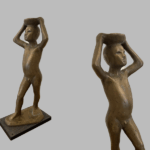
«The Little Porter». 1912. Alexander Matveev. Bronze. Dimensions: 37×16×15 cm. Tactile model. Plastic, metallization (bronze). A full-length figure of a standing nude African boy. His posture shows no strain—his curved, streamlined body effortlessly overcomes the weight of his burden. The boy casually supports a light load placed on his head with his raised arms, bent at the elbows. He stands poised, resiliently leaning on his left leg, with his right leg slightly bent at the knee and extended forward. This work by Matveev reflects the sculptor’s fascination with African art. At the same time, the delicacy of the master’s touch, his sensitivity in handling sculptural form, and his taste for subtle yet profoundly meaningful plastic nuances are expressed here with particular fullness. Dimensions of the original: height 38 cm, width 16 cm, depth 17.55 cm. by Irina Savenko

Youth

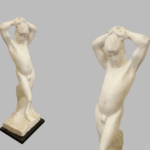
«Youth». 1911. Alexander Matveev. Marble. Dimensions: 158×49×37 cm. Tactile model. Plastic. A full-length figure of a standing nude youth. The lean young body curves like an elongated Latin letter S. Muscular arms are raised, bent at the elbows, and clasped behind the head. The head is tilted to the right and downward, with a serene expression. He stands on his straight left leg, while the right leg is bent at the knee and extended forward. Behind the sculpture, a low column with a rough, stone-like texture merges into the base. The sculpture «Youth» ranks among Alexander Matveev’s finest early works. It was created when the artist was still formulating the principles of his future sculptural method—drawing from Impressionism a profound love for the illusory, and from Symbolism and Art Nouveau a pull toward motifs of serene slumber, phantom dreams, and images of fragile, precarious balance hovering between reality and vision. The sculptor sought harmony, balance, and a synthesis with the natural world. Alexander Terentyevich Matveev (1878–1960), one of the most authoritative masters of 20th-century Russian sculpture, was born in Saratov. He studied at a drawing school and attended an amateur studio under the Saratov Society of Fine Arts. Interaction with talented young artists—including those who would later gain renown, such as V. E. Borisov-Musatov, P. V. Kuznetsov, and K. S. Petrov-Vodkin—shaped Matveev’s artistic interests and aspirations. He honed his skills at the Moscow School of Painting, Sculpture, and Architecture (1899–1902). Matveev actively engaged in creative and educational work, participating in and organizing numerous art and sculpture exhibitions. Matveev welcomed the October Socialist Revolution. In line with Lenin’s plan for monumental propaganda, he created a statue of Karl Marx—energetic and powerful, with rough, laconic forms. The monument was installed in Petrograd in 1918 but was soon dismantled. In the 1920s, the master worked for the Petrograd Porcelain Factory, producing a series of refined small-form sculptures. For the 10th anniversary of the Revolution, Matveev created the sculptural group «October,» whose boldness and innovation made it a milestone in Soviet sculpture. The figures of a soldier, a peasant, and a worker, executed according to the ancient canon of «heroic nudity,» were intended to express the three leading social forces of the revolution. From the late 1930s, the sculptor repeatedly revisited the image of Alexander Pushkin, which evolved in his numerous works from a relatively harmonious, «luminous» portrayal (though based on the poet’s death mask) to a «dark» one, imbued with profound inner tragedy. Matveev also worked extensively on portraits of prominent figures in Russian culture and politics (Herzen, Lermontov, Gorky, Chekhov, Yermolova, Lenin, among others). These works embody Matveev’s finest achievements—realism, plastic perfection, and psychological depth. Perhaps the pinnacle of Matveev’s art and an expression of his creative credo is his «Self-Portrait,» created in 1941. The simple and clear compositional solution, the precise structure of the head—understood as an architectural creation, a temple and vessel of the spirit—along with its confident, freely modeled forms, convey the life-affirming power of a mature creator. Matveev’s legacy is modest in volume. Yet his virtuoso skill left a significant mark on the tradition of Russian sculpture—he was also a remarkable teacher. For many years, Matveev taught at the Leningrad Academy of Arts, and after moving to Moscow, at the V. I. Surikov Moscow Art Institute. by Irina Savenko
Kore

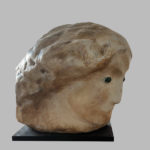
«Kore». 1912. Sergei Konenkov. Marble. Dimensions: 30.5×24×35 cm. Tactile model. Plastic. The sculpture depicts a young woman’s head, imitating the color and texture of light beige painted marble. The head closely resembles those of ancient Greek statues found in art museums worldwide. It is slightly tilted forward, as if the figure were meant to portray a swimming maiden or one walking against a strong wind. The hair framing the face on all sides retains the rough texture of untreated stone, while the face is finely polished. Widely spaced, convex eyes with round pupils are painted bright green. The nose is straight and slender, and the mouth is only faintly defined, its form reminiscent of an archaic smile. The lower part of the face is intentionally unfinished, revealing the natural, unworked texture of the stone. This artistic choice evokes the elemental force embodied by the goddess, while also giving her the appearance of an archaeological artifact. The sculpture «Kore,» blending portraiture with abstract allegory, was created by Sergei Konenkov in 1912 during his period of fascination with ancient Greek art. Sergei Timofeevich Konenkov (1874–1971) was often called the «Russian Rodin.» In his work, the sculptor sought to move beyond the naturalism and academicism of the 19th century. His innovative tendencies led him to explore Greek archaic art and folk traditions, as well as to prefer solid sculptural materials such as marble and wood over traditional clay. Konenkov achieved great success as a master portraitist, with his most representative works often drawing on fairy-tale and mythological themes. In ancient Greek mythology, Kore—meaning «maiden»—was one of the names of the goddess Persephone, the deity of agricultural fertility. This explains the choice of material (marble), the polychrome or multi-colored painting (reflecting the known Greek practice of painting sculptures), and the combination of a generalized, scarcely individualized treatment of the young woman’s facial features. by Irina Savenko