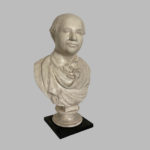
«Portrait of the Scientist M.V. Lomonosov». 1793. Fedot Shubin. Plaster. Dimensions: 73.5×46.5×29 cm. Tactile model. Plastic. This intimate portrait is recognized as one of Fedot Shubin’s finest sculptural works, distinguished by its realism and multifaceted characterization. Lomonosov is depicted without a wig, his head slightly raised, with a spiritual and contemplative expression. He has a prominent, domed forehead. Short curly hair lightly covers his ears, temples, and neck. Thick eyebrows are raised in a look of surprise, and his gaze is directed to the right and slightly upward, as if the scientist is observing an object that has fully captured his attention. The nose is large and straight, the cheeks are full. A subtle smile plays on his lips, with the lower lip slightly protruding. The chin is strong and well-defined. Mikhail Vasilyevich is dressed in a simple shirt with a turn-down collar and a modest jabot—a type of frilled neckwear. A cloak is draped over his shoulders, thrown over the left shoulder and resting on the right, forming deep, sharply defined folds across the chest. The cloak resembles the garments of great figures of antiquity. When viewed in profile, the sculpture reveals a different dimension of the subject: the dreamy, lyrical expression gives way to strength and dignity. The portrait captures a man who is perceptive, focused, courageous, strong-willed, yet also modest, unpretentious, and good-natured—qualities admired by the great scientist’s contemporaries. Mikhail Vasilyevich Lomonosov was a renowned Russian scientist, polymath, artist, poet, and writer of the 18th century. During the rise of Classicism in the second half of the 18th century in Russia, key societal ideals emerged: the possibility of constructing an ideal state, harmonious relations between humanity and nature, patriotism, civic duty, the creation of a «new fatherland,» and the intrinsic value of the individual beyond social class. Artists and sculptors drew inspiration from classical antiquity, as known through literary, sculptural, and architectural monuments. Antiquity was perceived as an era of free personal development and human spiritual and physical perfection. In Russia, sculptors of this period primarily depicted heroes of the ancient world. However, Fedot Ivanovich Shubin chose his own path. He was drawn to the possibility of revealing individual character through sculpture and left behind a remarkable portrait gallery of his contemporaries. Shubin focused on busts, paying close attention to the faces of his subjects while treating clothing with less emphasis. To fully appreciate the person depicted, each work must be viewed from two angles: frontally and in profile. by Irina Savenko
Месяц: Октябрь 2025
持球的女子运动员
《持球的女子运动员》。1930年。大卫·亚克松。陶瓷,珐琅。尺寸:23×39厘米。触觉模型。塑料。 矩形雕塑浮雕。在带有斑驳纹理的深红色背景前,一位年轻女运动员身着黑色运动泳装,正在做出投球动作。她浅色头发,留着波波头发型。面部神情沉着而专注。少女头部倾向持球的左手,右臂则大幅度向右伸展。躯干呈正面展示,双腿扭转,整个身形如弹簧般拧转,在这一动态中蕴含着强烈的表现力。姿态充满动感,是一个极为舒展的腾空动作,近乎一字马。 雕塑浮雕(译自意大利语,意为凸起、隆起)是雕塑的一种形式,其特征是在平面背景上呈现凸起的图像。本例作品属于浅浮雕,图像凸起高度不超过整体厚度的一半。以平面为基底的特性使浮雕区别于完全占据三维空间的圆雕。 这件由大卫·亚克松(1896-1947)创作的装饰浮雕以体育为主题,可追溯至20世纪30年代。当时的苏维埃新政权正通过国家意识形态大力推广群众性体育文化。彼时主导的社会理念是通过全民体能提升来塑造理想的未来人类——即新一代苏维埃人。艺术创作被赋予服务这一理念的使命。因此作品中体格健硕的持球运动员形象,正是要展现这种经过体能锻造的、典范式新人类的力量与气魄。 值得补充的是,此类艺术处理手法符合俄罗斯雕塑家协会大师们的美学追求——他们始终致力于为当代题材寻找充满力量的表达形式。对于人类及其社会角色的新理解,首先通过艺术材料本身得以呈现,这包括造型媒介的选择与图像表现手法的运用。 by Daniil Dolgikh
Sportswoman with a Ball
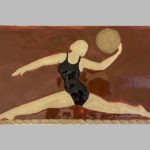
Sportswoman with a Ball «Sportswoman with a Ball». 1930. David Yakerson. Ceramic, enamel. Dimensions: 23×39 cm. Tactile model. Plastic. A rectangular sculptural relief. Against a dark red, streaked background stands the figure of a young sportswoman in a black athletic swimsuit, captured mid-throw. She has fair hair cut in a bob. Her expression is calm and focused. The girl’s head is tilted toward her left hand, which holds the ball, while her right arm is extended widely to the right. Her torso is shown frontally, but her legs are turned, twisting her body like a coiled spring — a pose imbued with great expressiveness. The stance is dynamic, depicting an extraordinarily wide leap, almost a split. A sculptural relief (from the Italian for «protrusion, convexity, elevation») is a type of sculpture featuring a raised image set against a flat background. In this case, you see a bas-relief, where the projection from the background does not exceed half the volume. The use of a flat background distinguishes relief from freestanding sculpture, which occupies full three-dimensional space. This decorative relief by David Yakerson (1896–1947) is dedicated to the theme of sports and dates to the 1930s. This was a period when, in the new Soviet state, official ideology actively promoted mass physical culture and sports. The prevailing idea was the creation of an ideal future human — the new Soviet person — through universal physical improvement. Art was called upon to serve this vision. Hence, the subject of this work — an athletic sportswoman with a ball — embodies the strength and power of a physically developed, exemplary new human being. In conclusion, it is worth noting that such an approach is characteristic of the aesthetic of the ORS masters (Society of Russian Sculptors), who consistently sought energetic, expressive forms for contemporary themes. The new understanding of the individual and their role in society found reflection in art primarily through materiality itself — including the choice of sculptural means and representational techniques. by Daniil Dolgikh
人体形态组合
《人体形态组合》。1922年。鲍里斯·科罗廖夫。青铜。尺寸:131×45×54厘米。触觉模型。塑料,金属化处理(青铜)。 雕塑由复杂的几何体块构成。形态与比例高度抽象,通过对角线构图营造出动态感。头部呈现为多层几何体,标有鼻梁线条、右眼与左耳。躯干由若干尖锐的棱角块面构成,可辨识出肩膀、脊柱线条与手臂。左臂如细长杆件抵在弯曲的左膝大腿处,右臂肘部弯曲,四指手掌置于臀部的圆形体块上。躯体由笔直的右腿支撑,腿型似弯曲柱体。左大腿体量厚重,与形似木质海盗假肢的细棍状小腿形成强烈对比。雕像立于方形基座之上。 艺术家在此作中运用了»生长型»空间 motif——这种近乎与建筑争锋的纪念碑式形态。作品既融合了正统立体主义的造型意识(体现为简化几何体块的理性追求),又重构了对原始艺术的塑性记忆。科罗廖夫创作探索的独特性在于他对待自然的态度——无论对»模特»进行何等强烈的变形处理,自然印象始终是其构图根基。这尊接近真人尺度的雕塑,堪称立体主义造型体系与深度重构的原始塑性记忆的完美融合。 翻译注解 by Arseniy Danilov
Conjugation of Human Body Forms
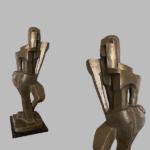
«Conjugation of Human Body Forms». 1922. Boris Korolyov. Bronze. Dimensions: 131×45×54 cm. Tactile model. Plastic, metallization (bronze). The figure consists of complex geometric volumes. The forms and proportions are highly stylized, and the pose conveys dynamism through diagonal lines. The head is depicted as a multi-layered volume, with the outline of a nose, the right eye, and the left ear indicated. The torso is formed by several sharp, angular volumes. The shoulders, the line of the spine, and the arms are discernible. The left arm, resembling a long, thin rod, rests on the thigh of the bent left leg. The right arm is shown bent at the elbow, with a four-fingered hand placed on the right buttock, which is rendered as a rounded volume. The figure stands on the straight right leg, which resembles a crooked pillar. The volume of the left thigh is much more massive than the thin, stick-like shin, evoking the image of a wooden pirate’s peg leg. The figure stands on a square pedestal. In this sculpture, the artist employs the motif of a form that «grows» into space, almost rivaling architecture in its monumentality. This work combines the plastic language of orthodox (classical) Cubism—with its rational impulse toward geometric simplification of volumes—and a reinterpreted «reminiscence» of primitive plasticity. The distinctiveness of Boris Korolyov’s artistic quest is defined by his approach to nature, the impressions of which always underlay his compositions, no matter how strongly he transformed the «model.» Moreover, this large-scale figure, nearly life-sized, seems to merge the plastic culture of Cubism with a deeply reimagined «memory» of primitive art. by Arseniy Danilov