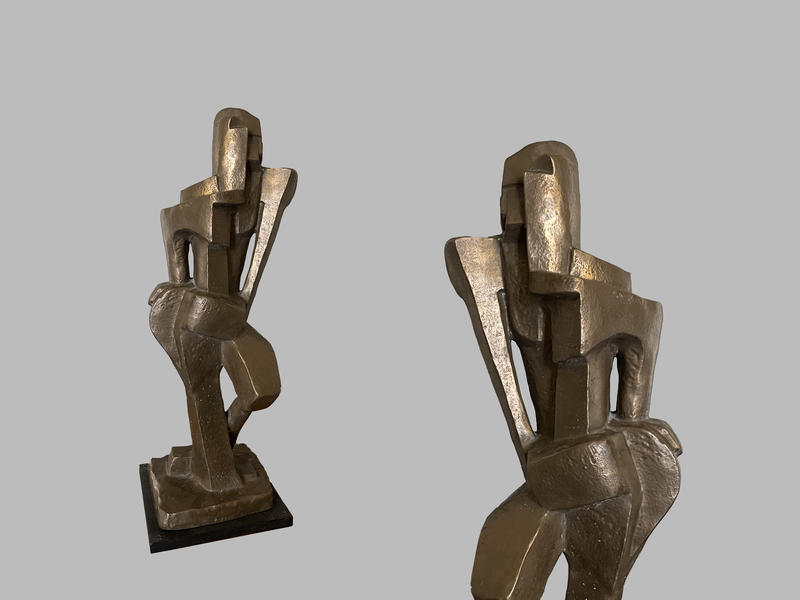
«Conjugation of Human Body Forms». 1922. Boris Korolyov. Bronze. Dimensions: 131×45×54 cm. Tactile model. Plastic, metallization (bronze).
The figure consists of complex geometric volumes. The forms and proportions are highly stylized, and the pose conveys dynamism through diagonal lines. The head is depicted as a multi-layered volume, with the outline of a nose, the right eye, and the left ear indicated. The torso is formed by several sharp, angular volumes. The shoulders, the line of the spine, and the arms are discernible. The left arm, resembling a long, thin rod, rests on the thigh of the bent left leg. The right arm is shown bent at the elbow, with a four-fingered hand placed on the right buttock, which is rendered as a rounded volume. The figure stands on the straight right leg, which resembles a crooked pillar. The volume of the left thigh is much more massive than the thin, stick-like shin, evoking the image of a wooden pirate’s peg leg. The figure stands on a square pedestal. In this sculpture, the artist employs the motif of a form that «grows» into space, almost rivaling architecture in its monumentality. This work combines the plastic language of orthodox (classical) Cubism—with its rational impulse toward geometric simplification of volumes—and a reinterpreted «reminiscence» of primitive plasticity. The distinctiveness of Boris Korolyov’s artistic quest is defined by his approach to nature, the impressions of which always underlay his compositions, no matter how strongly he transformed the «model.» Moreover, this large-scale figure, nearly life-sized, seems to merge the plastic culture of Cubism with a deeply reimagined «memory» of primitive art.
by Arseniy Danilov