Two-Faced Janus

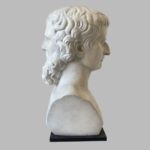
Two-faced Janus. Early 18th century. Unknown author. Marble. Dimensions: 56x34x31 cm. Tactile model. Plastic. Janus is the two-faced god of ancient Roman mythology. The young face of Janus is on the right. The youth has short curly hair, with large strands falling onto his temples, and a high forehead covered with bangs. There is some tension in his face, with shallow folds appearing between his eyebrows. His almond-shaped eyes have a confident gaze directed forward. He has a large nose with a slight bump. His mouth is small and tightly closed. His chin is broad and prominent. His neck is large and muscular, presenting a masculine and strong image. On the left side is the face of Janus as an old man. He is depicted as an ancient sage. Curly hair frames his face, covering his ears and falling onto his forehead in thick strands. There are two deep wrinkles on his forehead. His gaze is calm and direct. There are wrinkles at the corners of his eyes and slight puffiness under them. His nose is straight. His mouth is slightly open. Long mustaches transition into a thick, lush beard. Currently, the sculpture is exhibited in the Mikhaikovsky (Engineering) Castle. In Roman mythology, Janus is the god of entrances and exits, as well as the patron of all beginnings. Under his protection were all doors of all buildings in the world («private, public fields, temples, etc.), as well as gates (including city gates). Since Janus kept track of time, the Roman numeral CCC (three hundred) was inscribed on the fingers of his right hand, and LXV (sixty-five) on his left, which together make up the number of days in a year; moreover, the first month of the year, January, is named after Janus. Janus was also the deity of the sky and sunlight, who opened the heavenly gates and released the sun into the sky, and closed them at night. There was a belief that Janus could clearly see everything in the past and the future. For this dual ability, Janus began to be depicted with two faces: a young one, facing the future, looking to the right from the viewer, and an old one, looking back into the depths of time, to the left from the viewer. Typically, the viewer sees both profiles of Janus simultaneously. The depiction of the god with two heads allows for various interpretations of Janus. He becomes a symbol of any contradiction: external and internal, soul and body, myth and reason, right and left, conservative and progressive, matter and antimatter. All dialectics find their plastic synthesized embodiment in this god. The expression «two-faced Janus» today symbolizes everything ambiguous, equivocal, dual, ambivalent—the positive and negative aspects of the same action or thing. by Irina Savenko

Пой и учись (Sing&Learn)

Одно из многих практически готовых упражнений хочу предложить вам 🙂 В двух приведенных ниже карточках надо выбрать правильный вариант (упражнение на выбор (choice)) и произнести всю фразу под запись. Жду ответы в комментариях 🙂 Watch the video above several times. Then start the test. Look at the picture and choose the right option. Press the «Complete» button when the exercise is done. И еще одна карточка (из шести): Прослушайте видео выше столько раз, сколько вам потребуется, чтобы записать текст. И сразу второй отрывок:

Portfolio 1

Не могу не поделиться с вами радостью: на днях самый юный и активный волонтер нашего проекта English: all inclusive («Английский язык: всё включено и все включены») Абдурашидова Нурият (нам привычнее слышать ее второе имя Сапият 🙂 ) стала победительницей международного конкурса-фестиваля музыкально-художественного творчества «ДИВНЫЙ ОСТРОВ» в номинации «Эстрадный вокал»! ПОЗДРАВЛЯЕМ Сапият и ее замечательных родителей с этой заслуженной победой!!! Нашла странички из любимых книжек моих дочерей 🙂

1 Вы Бывали в Русском музее? (Have You Ever Been to the Russian Museum?)

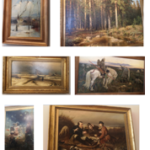
Конечно же, практически все скажут: «Да! И не раз!» Но я предлагаю снова отправиться в любимый музей с необычным заданием 🙂 Давайте позанимаемся английским в новой обстановке! Why not?! (Почему бы и нет?!) Good luck! (Желаю успеха!) Key: 1 Алексей Саврасов «Грачи прилетели» (1871) 2 Иван Шишкин «Корабельная роща» (1898) 3 Федор Васильев «Оттепель» (1871) 4 Виктор Васнецов «Витязь на распутье» (1878) 5 Илья Репин «Садко» (1876) 6 Василий Перов «Охотники на привале» (1871) 7 Илья Репин «Бурлаки на Волге»(1870-1873) 8 Василий Суриков «Взятие снежного городка» (1891)

‘И я.’

Мы с вами уже начали активно использовать в проектах грамматическую структуру ‘раньше’ (used to +V), которая очень украсила нашу речь 🙂 А теперь давайте изучим простую, но очень «вкусную» конструкцию, которая поможет нам уверенно общаться, соглашаясь с чем-либо, как например, в следующих диалогах: Согласитесь, хочется уметь сказать это правильно? A еще умение согласиться с предложенными утверждениями даст дополнительные быллы в тесте на уровень английского языка! Итак, начнем изучать тему «Согласись.» (Agree.) — такие задания обозначаются галочкой (V — tick) — с утвердительных предложений, которые договоримся помечать знаком плюс (+). Руководствуясь таблицей времен (самоучитель стр. 430) и приведенной выше формулой утвердительного предложения, получаем в переводе такие диалоги: Домашнее задание на эту тему получила и третьеклассница-отличница Сапият, сумевшая практически синхронно перевести несколько моих предложений без особых затруднений , потому что уже научилась находить в любом предложении глагол, определять его время и применять формулы изученных шести (из 12) времен! Еще ей понравилось, что писать в таком упражнении приходится совсем немного — зато знать надо уйму всего из английской грамматики 🙂 А задание я придумала в этот раз необычное — и мне самой оно очень нравится! В этот раз мои предложения — о любимом Санкт-Петербурге 🙂 На первый взгляд, они выглядят устрашающе: длинные фразы, много незнакомых слов(( Don’t panic! (Без паники!) Весь фокус в следующем: вы увидите имена известных скульпторов, названия любимых театров, музеев, улиц и площадей — но вы всё сумеете перевести, понять БЕЗ словаря, если просмотрите страницу 20 самоучителя, где узнаете, как на английском языке пишутся русские имена, и устно выполните предлагаемое упражнение, сверяясь с ключами на этой же странице! Итак, от вас требуется только дописать пропущенные слова в предложениях типа ‘И я.’ Чтобы упростить задачу, я выделила жирным шрифтом глаголы, от которых зависят ваши ответы 🙂 Ex. 1 Fill in the gaps. (Заполните пропуски.) 1. I’m proud of (гордиться) being a Petersburger. — __ __ I. 2. I really enjoy walking along (гулять по) Nevsky Prospekt. — __ __ I. 3. The Admiralty is located in Nevsky Prospekt (Avenue), and __ __ the Alexander Nevsky Monastery which is three miles (4.5 km) away! 4. The Monument to A.S. Pushkin (sculptor M.K. Anykushin, architect B.A. Petrov, 1957) is located in the Square of the Arts, and __ __ the Mikhailovsky Theatre. 5. The Mikhailovsky Palace, which houses the Russian Museum, was designed by architect Carlo Rossi, and __ __ the Alexandrinsky Theatre in Ostrovsky Square. 6. I’ve been to the Russian Museum several times (несколько раз). – __ __ I. 7. I went there to visit a new exhibition (выставка) last month. — __ __ I. Good luck! (Желаю успеха!) ________________________________ Key: 1 2 3 4 5 6 7 Do you agree with me that it isn’t so difficult? (Согласитесь, что не так страшно? :)) Key (Ex. 2): 1 so is 2 Neither/ Nor have 3 neither/ nor can 4 So do 5 So did 6 neither/ nor do 7 so was 8 neither/ nor will 9 So do 10 Neither/ Nor was

3 Руки&ноги (Arms&legs)

1.Arms (Руки) Basic on the left. (Основное движение слева.) Twice Jab, Cross, Hide-Hide. (Двойной Джеб, Кросс, Защита-Защита (прятаться)) Cross, Shoulder, Uppercut! (Кросс, Плечо дальнее влево вниз, Апперкот!) Добившись слаженности и четкости, выполняем всю связку из стойки справа (on the right). 2. Legs (Ноги) Basic on the left. (Основное движение слева.) Jab, Knee, Kick, Cross! (Джеб, Колено, Кик, Кросс!) Three times Jab, (Три Джеба,) Three times Jab down. (Три Джеба внизу, присев.) Bыполняем всю композицию из стойки справа (on the right). Ex. Translate into English. 1. Дай мне твою руку. 2. Не останавливайтесь! Продолжайте! 3. Всегда извиняйся за то, в чем виноват. (см предложение 5 в упр. Ex. в статье 3) 4. Пожалуйста, отпустите его домой. (см ‘Отпустите меня.’ в статье 3) 5. Не позволяйте (let) нам сидеть дома (stay home) и лениться (be lazy)! Key: ______________________________________________ 1. Give me your hand. 2. Don’t stop! Go on! 3. Always apologize for things that are your fault. 4. Please let him go home. 5. Don’t let us stay home and be lazy! 3. Arms & Legs (Руки & Ноги) Start on the left. Basic. Cross (with your right (!) arm), Jab, Hook, Kick, Uppercut! Hide forward, Jab, Cross! Hide back, Step back, Uppercut! Go! (Вперёд!) Watch the video and do the same! (Смотрите видео и делайте то же самое!) 4. Arms & Legs (Руки & Ноги) Start on the left. Basic. Jab, Knee, Three uppercuts! Cross, Kick, Cross, Hook! Do the same on the right. (То же самое справа.) Наслаждайтесь и вы, отрабатывая эти замечательные связки под музыку, проговаривая команды вслух на английском! Музыку из видео можно использовать для любых комбинаций.

The Summer Garden

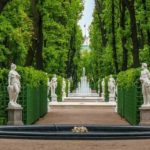
The Summer Garden is a park ensemble and a monument of landscape art from the first third of the 18th century in St. Petersburg. It was laid out by order of Peter I in 1704. Today, the Summer Garden is a branch of the Russian Museum. Within the ensemble of the Summer Garden, alongside architectural structures, fountains, and garden plantings, decorative garden sculpture plays a significant role — freely standing marble statues and busts, comprising thirty-eight statues, five sculptural groups, forty-eight busts, and one herma. The majority of these works were created by Italian masters from the late 17th to early 18th centuries and were delivered to St. Petersburg shortly after its foundation. As part of the comprehensive restoration and reconstruction of the Summer Garden carried out between 2009 and 2011, the original sculptures were restored and moved to the halls of the Mikhailovsky Castle of the Russian Museum. Replicas made of artificial marble were installed in the garden. by Irina Savenko

Woman with a Lyre. Allegory of Music

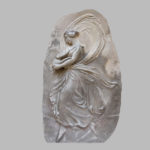
«Woman with a Lyre. Allegory of Music». 1820s. Unknown Artist. Plaster. Dimensions: 80×48 cm. Tactile Model. Plastic. A rectangular slab with uneven edges bears a relief depiction of a young woman playing a lyre. The figure is shown in profile. Her head is slightly tilted downward, with her hair gathered in a style at the back of her head. With her left hand, she supports the lyre, while her right hand appears to glide over the strings. A long, flowing dress envelops her figure, its numerous folds emphasizing movement. A scarf billowing from her waist forms an oval loop above her head. The woman’s bare feet step in an elegant stride, as if she were floating in the air. This relief is a pair to the «Allegory of Dance,» hence sharing similar dimensions. The depiction of the lyre is symbolic—the woman playing the lyre represents Music itself. The lyre, a musical instrument, was played by Apollo, the god of the arts, according to ancient Greek myths. Reliefs with such themes adorned both music salons and concert halls, contributing to an atmosphere of elevated classical art. It must be acknowledged that they fulfilled this role admirably. by Irina Savenko

The Stroganov Palace. Architect: Francesco Bartolomeo Rastrelli. Tactile Model.

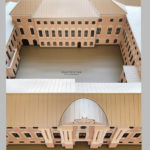
The Stroganov Palace. Architect: Francesco Bartolomeo Rastrelli. Tactile Model. Here is a model of the Stroganov Palace. The length of each facade is 73 meters along Nevsky Prospect and approximately 50 meters along the Moika River. The height of the palace is about 15 meters. The three-story building is pale pink with white decorative elements. Following tradition, the central floor—the piano nobile—was designated for state rooms. This floor houses the palace’s main halls. The first, lowest floor contained service premises, while the third floor was intended for living quarters. The facades facing Nevsky Prospect and the Moika River feature similar compositions: at the center of each is a portico crowned by a pediment bearing the Stroganov coat of arms. The coat of arms is shown on the label in an enlarged scale. A portico is the central, colonnaded section of a facade, topped by a pediment. On the Moika side, the pediment is triangular, and the portico features a balcony with an ornate wrought-iron railing. The windows of the palace’s main hall—the Ballroom—open onto this side. On the Nevsky Prospect side, the pediment is semicircular. The windows of the piano nobile are adorned in their lower part with a decorative Baroque grille, a fragment of which can be explored tactilely in a larger scale. The central sections of the facades are decorated with pilasters (flat columns attached to the wall) and columns. In addition to other plastic decorations, both facades of the palace are adorned with lion masks above the second-floor windows and portrait medallions beneath them. According to one version, these bas-relief portraits depict the palace’s first owner, Baron Sergei Stroganov, whom Rastrelli sought to surprise in this manner. However, many historians claim that the famous architect placed his own profile on the palace walls as a kind of authorial signature to immortalize his work. Yet a third version suggests that Jean-Baptiste Vallin de la Mothe, who completed work on the Rastrellian facades, might have left his profile as a mark of his participation in this prestigious project. A medallion is shown in greater detail on the label in an enlarged scale. Coat of Arms Description: A shield featuring a bear’s head, diagonally divided by a wavy bend bearing three arrowheads, supported by two sables standing on their hind legs. The shield is crowned by a baronial coronet. These sables, like the bear’s head, are symbols of Siberia, signifying that the Stroganov ancestors were among the organizers of Yermak’s campaign into Siberia and contributed to the region’s conquest by Russia. The formation of the palace began presumably in the 1720s, when single-story chambers were built near the Green Bridge over the Moika River, belonging to one of the Stroganovs, possibly the entire family. In 1742, Baron Sergei Grigoryevich Stroganov purchased an unfinished two-story house on the same site. Subsequently, all buildings were unified into a single whole. Work on the palace was carried out in 1754–55. The dynasty continued to own it until 1918. Then, in 1921, the last male member of the Stroganov family, Sergei Alexandrovich, specifically traveled to Petrograd from France to hand over the keys of the palace to the People’s Commissar of Enlightenment, A.V. Lunacharsky. He never returned to Russia. The palace is situated at the intersection of Nevsky Prospect and the Moika River. In this part of St. Petersburg, it is the only building retaining features of Baroque architecture. The palace was the most significant among the numerous properties of the famous Stroganov family. The list of architects who contributed to the palace is extensive and illustrious, including the Italians Francesco Bartolomeo Rastrelli and Carlo Rossi, the Frenchman Jean-Baptiste Vallin de la Mothe, and the Russian architectural genius Andrei Voronikhin—a former serf—among many other renowned architects. Permission to purchase the land was granted by Empress Elizabeth Petrovna herself. With her approval, the court architect Francesco Bartolomeo Rastrelli, who executed commissions exclusively for the imperial family, was engaged for the construction. by Irina Savenko

The Wanderer

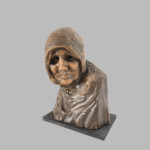
«The Wanderer». 1903. Anna Golubkina. Wood. Dimensions: 42×29×18 cm. Tactile model. Plastic. This intimate bust sculpture depicts a woman wrapped in a headscarf that covers her head, falling to her eyes and draping in folds over her shoulders. Her head is slightly lowered and turned to the side, shoulders raised, back hunched—as if some invisible burden weighs upon this fragile, slender figure. The folds of the scarf are rendered with broad, swift, sketch-like chisel strokes. Deep hollows replace her eyes, seemingly absent, leaving only darkness beneath brows raised and drawn toward the bridge of her nose. The uneven oval of her aged face, a prominent nose, compressed sunken lips, and a small chin complete the visage. The woman appears immersed in her thoughts, detached from her surroundings. The sculptural bust «The Wanderer» belongs to Anna Golubkina’s early works. The sculptor portrayed an elderly pious woman whom she encountered in Zaraysk and asked to pose for a portrait. Original dimensions: height 42 cm, width 29 cm, depth 18 cm. Golubkina masterfully employs the interplay of light and shadow by deeply carving these facial features into the wood. So deeply concealed is the gaze in this weary face… What does it conceal? How much has this wanderer endured, experienced, and borne in her life? Anna Semyonovna Golubkina (1864–1927) was the first Russian woman sculptor whose work became a symbol of the flourishing of Russian plastic arts in the first third of the 20th century. She stands as one of the leading masters of the Silver Age—a period in Russian culture marked by outstanding achievements in literature, music, and painting. In her sculptural works, Golubkina vividly conveyed the atmosphere of her time—its emotions, anxieties, and mystical premonitions. Anna Semyonovna transformed the classical approach to plasticity, material, and working from life. She possessed a subtle sensitivity to materials—marble, wood, clay—and their expressive potential and decorative qualities. Her work is often associated with Impressionism and Symbolism, the dominant artistic movements at the turn of the 20th century. Her interactions with the renowned sculptor Auguste Rodin and his guidance helped Golubkina realize her own artistic path. In her creative practice, Anna Golubkina was guided by the idea of selfless devotion to art: «One must forget everything, give everything.» by Irina Savenko

Female Head

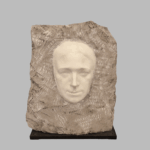
«Female Head.» 1902-1903. Anna Golubkina. Marble, limestone. Dimensions: 44×36×20 cm. Tactile model. Plastic. The sculpture consists of a stone block featuring a high-relief female head protruding from its surface. The rough, chisel-worked texture of the limestone contrasts with the smooth surface of the white marble face. The features include a high, clear forehead and delicate eyebrows. The gaze is calm beneath heavy eyelids, with a straight, sharp nose and firmly closed, slightly full lips. Anna Golubkina’s high-relief «Female Head» was created a decade before her sculpture «The Sleepers,» which partly echoes its general structural principle: in both works, the artist employs the technique of meticulously sculpting the face and head, which emerge from the «raw,» unworked stone as if from some natural or existential element. However, unlike the more complex and dynamic «three-part» sculpture, «Female Head» presents a static, strictly frontal compositional approach. A formal contrast is nevertheless present here as well. The carefully and smoothly detailed marble head of the model is set against a coarser, unpolished background of limestone, where the marks of the sculptor’s chisel are intentionally left visible. To reinterpret the metaphor of contrasting the human form with wild, untamed nature, one could say that the combination of different materials within a single composition emphasizes the spiritual quality of the female face: it seems to glow as it emerges from the surrounding «darkness.» In addition to the difference in stone textures, the variation in color contributes to this visual effect. by Irina Savenko

尤莉娅

《尤莉娅》。1925年。薇拉·穆希娜。着色石膏。尺寸:180×54×53厘米。触觉模型。塑料材质。 作品呈现站立裸女形象。身体表现略带程式化,体量厚重,具有立体主义风格。双臂缺失。头部向左下方扭转。躯干急剧左转,呼应头部动态,女子似在回眸瞻顾。丰臀健腿的肌肉被夸张强调,左腿膝部微屈。 薇拉·伊格纳季耶夫娜·穆希娜(1889-1953)之名在苏联时期已成为社会主义现实主义艺术的代名词与典范。然而这位大师的成名之路远非坦途。 穆希娜生于里加一个源远流商的显赫家庭,先后在费奥多西亚和库尔斯克居住。1909年迁居莫斯科开始研习绘画,后赴巴黎求学,游历法意两国研习古典艺术遗迹。一战爆发后,穆希娜立即参加护士培训课程,直至1918年中旬始终在野战医院服务,其间从未中断艺术创作。 十月革命后,穆希娜积极参与纪念碑宣传计划实施。1920年代致力于展览设计、杂志插画与海报创作。1920年代后半期起投身艺术教育事业。 其早期作品可见雕塑家逐步探索运用新兴造型语言——1930年代架上雕塑的»新身体美学»与纪念碑雕塑的巨构化倾向。这种新身体美学旨在塑造新世界人类的形象——强健而优美。 穆希娜的艺术发现尤显于大胆运用玻璃、不锈钢等新材料,其造型方案的革命性为艺术发展指明了通向未来的方向。 穆希娜作品的英雄形象——无论是纪念碑还是架上雕塑,具体人物还是典型形象——始终是那些执着创造、奋勇抗争、征服自然伟力与科学巅峰的崇高灵魂。 作品题名源自芭蕾舞者波德古尔斯卡娅,她为艺术家实现复杂艺术构思担任模特。然而舞者本身的纤柔优雅在这件作品中让位于刻意强化的厚重形体,由此催生出健美女性形象,成为凝聚活力、和谐匀称的健康身体典范。虽体量不大,雕塑却蕴藉着纪念碑式的恢宏气度。 制作:伊琳娜·萨文科

Julia

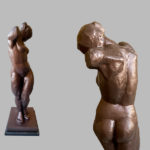
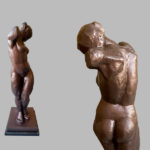
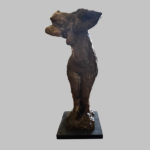
«Julia». 1925. Vera Mukhina. Tinted plaster. Dimensions: 180x54x53 cm. Tactile model. Plastic. A figure of a standing nude woman. The body is rendered somewhat conventionally, with a heavy, monumental quality, in a Cubist manner. The arms are absent. The head is turned to the left and downward. The torso is sharply twisted to the left, following the movement of the head, as if the woman is looking back. The hips and legs are large, with hypertrophied, emphasized muscles. The left leg is bent at the knee. The name of Vera Ignatyevna Mukhina (1889–1953) was a household name during the Soviet era and was considered the standard of Socialist Realism. However, the master’s path to fame was far from simple. Vera Mukhina was born in Riga into the family of a successful merchant from an old merchant lineage. She lived in Feodosia and then in Kursk. In 1909, she moved to Moscow, where she began studying painting. She studied in Paris. She traveled throughout France and Italy, where she studied monuments of classical art. Immediately after the start of the First World War, Mukhina completed courses for nurses and worked in military hospitals until the middle of 1918. Throughout this period, she did not abandon her artistic pursuits. After the October Revolution, Mukhina actively participated in the implementation of the monumental propaganda plan. In the 1920s, she worked on exhibition design, magazine graphics, and posters. From the second half of the 1920s, Mukhina engaged in teaching. Her early works show the sculptor’s path towards a strategy of openly using new visual means – a «new physicality» in easel works and gigantomania in the monumental sculpture of the 1930s. This new physicality was intended to form the image of a person of the new world – strong and beautiful. The boldness of Mukhina’s discoveries, especially in the use of new materials such as glass and stainless steel, and the radical nature of many of her plastic solutions, set a vector moving forward, towards the future. The heroes of Mukhina’s works – whether monumental monuments or easel sculptures, specific characters or typological images – are, first and foremost, those who purposefully create, passionately struggle, and inspirationally conquer the natural elements and the peaks of scientific thought. The title of the work is connected with the name of the ballerina Podgurskaya, who served as the model for the author’s complex artistic concept. However, the refined grace of the ballerina yielded in this work to the sturdiness of consciously weighted forms, which allowed for the birth of an image of a beautiful woman, a kind of standard of a healthy, energetic, and harmoniously built body. Despite its small size, the sculpture possesses a monumental appearance. by Irina Savenko

Standing Female Figure

«Standing Female Figure». 1915. Boris Korolyov. Bronze. Dimensions: 43×19×11.5 cm. Tactile model. Plastic, metallization (bronze). A stylized depiction of a female figure. The structure appears loosely formed, as if casually molded in a sketch-like manner. The image is soft and sensual. The torso leans to the right, evoking the trunk of a tree bending in the wind. The arms are bent at the elbows and extended to the sides. The head rests on the right arm as if the woman is sleeping, while the left hand touches her chest. The abdomen is full, slightly sagging. Heavy, broad hips transition into straight, closely set legs. The lower part of the legs merges with the base, forming a unified volume. Comparing the two studies, «Standing Male Figure» and «Standing Female Figure,» it can be said that the male form embodies a more rigid, resilient, and resolute essence, while the female form conveys a more sensual, passive, and compassionate quality. The figures share similar artistic objectives set by the sculptor, with nearly identical dimensions and stylistic execution. The «Female Figure» is distinguished by a distinct emphasis on the natural plasticity of the human body, aligning it more closely with «Impressionism» than «Cubism.» by Irina Savenko

Portrait of E.V. Derviz, Daughter of Artist V.D. Derviz

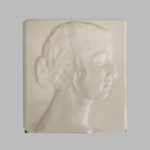
«Portrait of E.V. Derviz, Daughter of Artist V.D. Derviz». 1906-1910. Ivan Efimov. Porcelain. Dimensions: 25×27 cm. Tactile model. Plastic. A low sculptural relief depicting a female profile facing right. The contour of the face is clear and well-defined, with a distinct nose featuring a slight bridge. The eyes are set deep beneath the brows, with a direct gaze. The young woman’s hairstyle is traditional: her hair is swept upward from the forehead, partly braided into a plait at the back of the head, and gathered into a bun. The creative work of the renowned sculptor, graphic artist, illustrator, animalier, theater artist, reformer of puppet theater, and professor Ivan Semyonovich Efimov (1878–1959) belongs to the Soviet period. The artist’s creative interests were broad. Works by I.S. Efimov adorn stations of the Moscow Metro, the Yaroslavl and Leningrad railway stations in Moscow, the Khimki River Terminal, sanatoriums in Morozovka near Moscow, in Tskhaltubo (Georgia) and Sochi, as well as interiors of the Pushkin House in St. Petersburg. Ivan Efimov’s work is primarily dedicated to the animalistic genre. However, his extensive legacy also includes portraits of contemporaries, such as the presented portraits of E. Derviz and A. Bely. These portraits were created during the early period of the artist’s career, in the 1900s. At that time, he worked in «Abramtsevo,» the pottery workshop of Savva Mamontov, a famous theater director and patron of the arts. The presented portraits share several similarities (time of creation, material—both are made of porcelain—and their small format). However, they differ in their interpretation of the subjects. The modeling of the girl’s face appears classically concise and severe, yet the author succeeded in conveying the model’s character. It is worth noting that the portrait of E. Derviz, like that of A. Bely, is an intimate chamber work, almost private in nature. Such sculptural portraits were popular in the 19th and early 20th centuries and were intended for domestic interiors. by Irina Savenko

Portrait of the Writer Andrei Bely

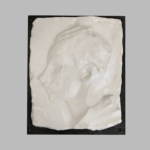
«Portrait of the Writer Andrei Bely». 1907. Ivan Efimov. Porcelain. Dimensions: 22×26 cm. Tactile model. Plastic. This relief portrait depicts a male profile facing left, executed in a free-flowing style. The facial features are somewhat softened: the gentle line of the nose and forehead, the faint mustache above the upper lip, and the loosely swept-back hair convey the liveliness and impetuous character of the subject. The barely suggested collar of the garment and the uneven, textured background indicate the preparatory stage of the relief’s execution. The combination of this irregular background with the delicate, subtle rendering of the young writer’s face creates a striking contrast, emphasizing the rebellious spirit of the subject. Executed in a highly unrestrained manner, the relief demonstrates the high professional skill of the sculptor I. Efimov, who managed to capture a convincing and memorable image even in a small format. This depiction of a young man in profile represents Andrei Bely as he appeared at the time. His face is oriented as if facing E.V. Derviz, and the relief shares the same dimensions and is likewise made of porcelain. Thus, these two reliefs form a pair. However, the portrait of Andrei Bely differs entirely in its interpretation and modeling: his profile lacks clear contours, and the sculpting manner is freely impressionistic, «unfinished,» as if the artist made a swift sketch from life. by Irina Savenko