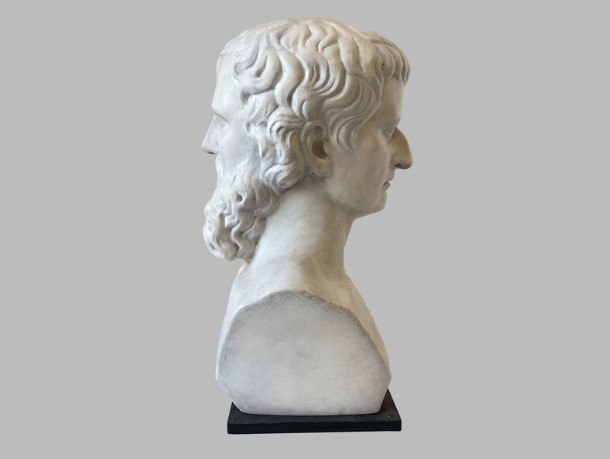
Two-faced Janus. Early 18th century. Unknown author. Marble. Dimensions: 56x34x31 cm. Tactile model. Plastic.
Janus is the two-faced god of ancient Roman mythology. The young face of Janus is on the right. The youth has short curly hair, with large strands falling onto his temples, and a high forehead covered with bangs. There is some tension in his face, with shallow folds appearing between his eyebrows. His almond-shaped eyes have a confident gaze directed forward. He has a large nose with a slight bump. His mouth is small and tightly closed. His chin is broad and prominent. His neck is large and muscular, presenting a masculine and strong image.
On the left side is the face of Janus as an old man. He is depicted as an ancient sage. Curly hair frames his face, covering his ears and falling onto his forehead in thick strands. There are two deep wrinkles on his forehead. His gaze is calm and direct. There are wrinkles at the corners of his eyes and slight puffiness under them. His nose is straight. His mouth is slightly open. Long mustaches transition into a thick, lush beard.
Currently, the sculpture is exhibited in the Mikhaikovsky (Engineering) Castle.
In Roman mythology, Janus is the god of entrances and exits, as well as the patron of all beginnings. Under his protection were all doors of all buildings in the world («private, public fields, temples, etc.), as well as gates (including city gates). Since Janus kept track of time, the Roman numeral CCC (three hundred) was inscribed on the fingers of his right hand, and LXV (sixty-five) on his left, which together make up the number of days in a year; moreover, the first month of the year, January, is named after Janus. Janus was also the deity of the sky and sunlight, who opened the heavenly gates and released the sun into the sky, and closed them at night. There was a belief that Janus could clearly see everything in the past and the future. For this dual ability, Janus began to be depicted with two faces: a young one, facing the future, looking to the right from the viewer, and an old one, looking back into the depths of time, to the left from the viewer. Typically, the viewer sees both profiles of Janus simultaneously.
The depiction of the god with two heads allows for various interpretations of Janus. He becomes a symbol of any contradiction: external and internal, soul and body, myth and reason, right and left, conservative and progressive, matter and antimatter. All dialectics find their plastic synthesized embodiment in this god. The expression «two-faced Janus» today symbolizes everything ambiguous, equivocal, dual, ambivalent—the positive and negative aspects of the same action or thing.
by Irina Savenko