Месяц: Сентябрь 2025

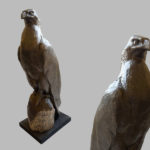
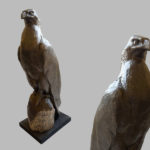
雄鹰 《雄鹰》。1927年。瓦西里·瓦塔金。木质。尺寸:89×25×34厘米。触觉模型。塑料材质。 这件雕塑以概括性手法呈现鹰的姿态。这只猛禽静栖于原木横截面上,头部向左扭转。头颅高昂,目光锐利如炬,弯曲的喙部锋锐有力。双翼紧收于身侧,仅可见单侧利爪。 瓦西里·阿列克谢耶维奇·瓦塔金(1883–1969)是杰出的雕塑家、画家、架上及书籍插画大师、教育工作者、教授和院士。同时作为著名动物学家,他是莫斯科国家达尔文博物馆的创始人之一。这位艺术家将毕生创作奉献给动物题材,成为俄罗斯重要的动物题材艺术大师。 在塑造动物与飞禽形象时,瓦塔金广泛运用多种材料:木材、大理石、金属、马约利卡陶器(以烧结粘土制成的彩绘陶艺)、象牙与玻璃,通过不同材质探索其造型表现力。 身为科学家的瓦塔精通知悉动物的形态结构、行为习性与生理特征,身为艺术家的他借此创造出极具表现力且令人过目难忘的动物形象。对他而言,展现动物的»心理肖像»,凸显其独特性格特征,完成具有原创性的»肖像»创作至关重要。 创作此雕塑期间,艺术家正痴迷于东方与古埃及神话体系——这些文化普遍存在将动物神化的神秘主义传统。在世界多重文化中,鹰是力量、尊严与威严的化身,亦是太阳的象征。同时,鹰更代表着高度、升华、挣脱束缚与无畏勇气。端详这件作品时,人们不禁发问:»这只鹰还能重返苍穹吗?»它身陷囹圄,且缺失一足。您对此作何解读?

EAGLE

«Eagle». 1927. Vasily Vatagin. Wood. Dimensions: 89×25×34 cm. Tactile model. Plastic. A generalized sculptural depiction of an eagle. The bird of prey sits calmly on a flat-cut log, its head turned to the left. The head is held proudly, with a sharp, piercing gaze and a curved, pointed beak. The wings are tightly folded. Only one leg is visible. Vasily Alexeyevich Vatagin (1883–1969) was an outstanding sculptor, painter, graphic artist (both easel and book illustration), educator, professor, and academician. Vatagin was also a renowned zoologist and one of the founders of the State Darwin Museum in Moscow. The artist dedicated his entire career to depicting animals, establishing himself as a leading Russian animalier (wildlife artist). For his sculptures of animals and birds, Vatagin employed a wide range of materials: wood, marble, metal, majolica (a type of glazed ceramic), ivory, and glass, striving to explore each material’s unique sculptural potential. His precise scientific knowledge of animal anatomy, movement, and behavior allowed Vatagin the artist to create expressive, memorable depictions of wildlife. He sought to capture the «psychological» essence of an animal, revealing its distinctive traits and crafting an original «portrait.» At the time of this sculpture’s creation, Vatagin was fascinated by the mythology of the East and ancient Egypt, where fauna was often mystically deified. Across many cultures, the eagle symbolizes strength, pride, grandeur, and the sun—but also height, ascension, liberation from constraints, and courage. Studying this sculpture raises a question: «Can this eagle still take flight?» It appears captive, with one leg missing. What do you think? by Sapiyat Abdurashidova

TIGER

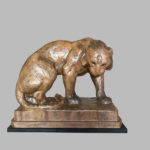
«Tiger». 1927. Vasily Vatagin. Wood. Dimensions: 59×70×35 cm. Tactile model. Plastic. The tiger is depicted in a distinctive «threatening» posture: it has raised its front paws, lowered its head, flattened its ears, and tucked its tail. Its eyes glare menacingly from under its brow, and one can almost hear its growl. The muscles are tense, as if poised for a leap. The tiger is a predator—strong and agile—and it is issuing a warning of danger. As a talented sculptor, V. A. Vatagin sought to move away from scientific rationalism and pedantic academic dryness. He employed artistic devices such as the formulaic generalization of volumes and expressive plasticity to convey the characteristic behavior of the animal. His works are succinct and recognizable «portraits» of animals, each with its own unique «character.» The sculptor repeatedly turned to depicting tigers in various techniques and materials. He drew Ussuri tigers in different situations from their lives, particularly enjoying portraying these large predatory cats stalking their prey. The copy of the sculpture presented in the exhibition, from the collection of the State Russian Museum, offers an opportunity to become acquainted with the nature of this powerful, predatory animal. The sculptor masterfully captured the tension of this moment, admiring the plasticity of movement and the beauty of this creature. by Arseniy Danilov

Woman with a Tambourine. Allegory of Dance

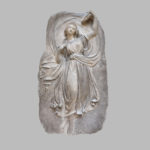
«Woman with a Tambourine. Allegory of Dance». 1820s. Unknown author. Plaster. Size: 83×50 cm. Tactile model. Plastic. On a rectangular slab with uneven edges is a relief image of a dancing woman. Her head is slightly tilted to the left, she is wearing a scarf, from under which wavy strands of hair are sticking out. The dancer’s face has perfect classical features and a spiritual expression, her gaze is turned upward. She seems to hear the music accompanying the beautiful dance. Her left hand is raised and slightly bent at the elbow, in it the girl holds a tambourine, her right hand touches her shoulder. The figure is gracefully curved and wrapped in numerous folds of a dress reminiscent of an antique chiton. They emphasize the rapid nature of the movement. The belt of the dress, transformed into a flying scarf, is thrown up and forms a round loop above the dancing woman’s head. The girl gracefully steps with one leg, the other leg is bent and hidden in the folds of her clothes. A sculptural relief is a type of sculpture that is a convex image located on a background plane. The use of a plane as a background distinguishes relief from round sculpture, so relief is designed only for frontal perception. Each of the reliefs has two names — a specific one («Woman with a Tambourine» and «Woman with a Lyre») and an allegorical one. Allegory is translated from Greek as «allegory». Allegory is understood as an artistic representation of ideas or abstract concepts through a specific image. That is, a phenomenon or concept is not named directly, but is depicted allegorically using other images or words. (For example, an allegorical symbol of medicine is a snake wrapped around a cup on a high leg). Allegory as an artistic device was widely used in the art of the 18th and 19th centuries. The decorative reliefs «Allegory of Dance» and «Allegory of Music» are an example of an allegorical depiction of such arts as Dance and Music. Both reliefs are approximately dated to the 20s of the 19th century, that is, they belong to the Classicism style. Classicism is characterized by an appeal to antiquity, a desire for ideal forms and a harmonious combination of details and the whole. by David Boles by Maria Kazakova

Standing Male Figure

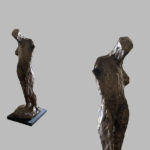
voiced by David Boles voiced by Daniil Dolgikh 🙂 «Standing Male Figure». 1914. Boris Korolyov. Bronze. Dimensions: 49×18×16 cm. Tactile model. Plastic. Metallization (bronze). A simplified, somewhat conventional depiction of a male figure. The structure is loosely defined, with forms approaching geometric shapes. The head is lowered and, together with the neck, forms a single volume of an indefinite, pointed shape. The face lacks distinct features. The arms are absent. The right shoulder is sharply lowered, and the back is arched. The silhouette is tense and rigid. The figure stands on a straight right leg, while the left leg is bent at the knee. The foot merges into the base, forming a unified whole with it. The sculpture represents a laboratory study of a nude model, executed in a generalized manner that reflects the young sculptor’s artistic directions—both a tribute to Impressionism and an attraction to Cubist aesthetics. The work clearly conveys the anatomical «framework» of the human figure: its emphasized S-shaped curvature—the anatomical curves of the spine—and an analytical approach to its construction, expressed through sharp, generalized volumes that compose it. Boris Danilovich Korolyov (1884–1963) was a monumental sculptor, educator, and public figure who stood at the origins of the Soviet sculptural school. His artistic evolution progressed from the aesthetic achievements of the avant-garde to a realist method of depiction. At the same time, Korolyov is considered arguably the only full-fledged representative of Cubism in Russian sculpture. Boris Korolyov was born in Moscow. In 1903, he entered the Faculty of Physics and Mathematics at Moscow University. He joined the revolutionary movement, was arrested twice, and was exiled abroad. From 1910 to 1914, he studied at the Moscow School of Painting, Sculpture and Architecture. In the early years following the October Revolution, Korolyov participated in organizing artistic institutions such as the Commission for Painting-Sculpture-Architectural Synthesis under the Collegium for Arts of the People’s Commissariat for Education, and the Society of Russian Sculptors. He taught at the Institute of Proletarian Fine Arts and elsewhere. Sharing the avant-garde belief in transforming society through art, in the post-revolutionary years Korolyov participated in implementing Lenin’s plan for monumental propaganda. Ironically, his monument to the political figure M. Bakunin, created in 1918, became the first work in Soviet art to be destroyed for formal and stylistic reasons. According to some sources, the monument was dismantled in 1919; according to others, it stood for less than a month. The broader sociopolitical changes in Soviet society compelled the sculptor to shift his aesthetic orientation in the late 1920s and turn to realism. In particular, this period includes a series of studies of the nude female figure. All these works are distinguished by their exceptional clarity and density of form. The 1920s–1930s marked the peak of the master’s creative period. As one of the leading monumental sculptors of the era, he participated in all major competitions for sculptural monuments held in the USSR at that time. He created a gallery of images of «heroes of his time»—L. Tolstoy, M. Gorky, I. Stalin, V. Lenin, among others. In his monumental projects, Korolyov sought an organic combination of sculptural principles and an architectural understanding of plastic tasks. B. D. Korolyov significantly contributed to defining the main direction of Soviet pre-war sculpture. However, the artistic language of his works was repeatedly subjected to harsh criticism. The most difficult period for the master was the early to mid-1950s, when he was labeled a «formalist.» by Daniil Dolgikh & Irina Savenko

Paul I

«Paul I». 1798. Fedot Shubin. Bronze. Dimensions: 74×47×33 cm. Tactile model. Plastic, metallization (bronze). A formal portrait of the emperor. His head is raised and turned to the right. He wears a wig with curls covering the ears, while a braid is loosened at the back, with wavy locks resting freely along his shoulders. The forehead is clear and very high. Thick eyebrows are raised. The eyes are large, slightly protruding, and gaze directly at the viewer. The nose is short and sharply upturned. The small mouth is tightly closed. The chin is large and prominent. A thin scarf is wrapped several times around the neck, with its end emerging near the chin. The emperor is depicted in knightly armor, draped with a cloak that covers his chest. The end of the cloak hangs from his right shoulder, falling in deep folds. Around his neck, partially hidden by the cloak, is the Order of St. Anne, his favorite order since childhood, inherited from his father, Peter III. A golden chain descends from his left shoulder, composed of alternating images of double-headed eagles, coats of arms, St. Andrew’s Crosses, and medallions. On the left side of his chest, beneath the cloak, the Order of St. Andrew the First-Called is visible. This order was the highest honor of the Russian Empire, consisting of an eight-rayed silver star with diamonds and the order’s insignia—a diagonal cross bearing the figure of the crucified St. Andrew the First-Called. Below, attached to the cloak, is the Order of St. John of Jerusalem in the form of an eight-pointed Maltese Cross. This work is one of the most extraordinary phenomena in 18th-century Russian art, in which the author managed to create a multifaceted and contradictory image of the autocrat. Skillfully utilizing the possibility of a circular view of the sculpture and breaking with unprecedented boldness all the canons of an idealized formal portrait, the master reveals the complexity and contradictions of one of the most tragic figures in Russian history. Interestingly, this brutally truthful portrait received official recognition. It contained no grotesque exaggerations and was distinguished by the splendor of its setting, very much to the emperor’s taste. When viewed frontally, the sculptural portrait of Paul I appears before the viewer with a proud turn of the head, a stern, authoritative expression, and a haughty gaze of intelligent eyes. Part 2 The profile viewpoint reveals another facet of Paul I’s nature. A creatively gifted individual, he was passionate about literature, music, art, and architecture, and from childhood dreamed of reviving the traditions of medieval knighthood with its code of honor, nobility, and worship of the Beautiful Lady. An intent gaze, a slight smile, and soft, smooth lines of the silhouette speak of Paul’s character, encapsulated in a single line by Pushkin: «our romantic emperor.» His long-awaited ascension to the Russian throne in 1796 was an event of exceptional importance for Paul I. Behind him were the years when the heavy emotional experiences of the tsarevich and his disagreement with the lifestyle and form of rule of his mother, Empress Catherine II, were masked by an appearance of complete submission to her will—years of impatient anticipation of the longed-for hour of vengeance for the murder of his father, Peter III. Henceforth, Paul I was the all-powerful autocrat, intending to put an end to the moral laxity of the Catherine era. Noble, well-mannered, and educated yet unstable, he aspired to be a strict and just monarch, never forgetting the knightly ideals of honor and morality. In 1798, at the request of the knights of the Order of Malta, striving to protect ancient spiritual values, Paul I became the Grand Master of this oldest knightly order. by Vitaliy Vertogradov
科学

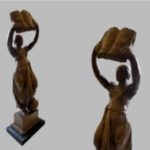
《科学》。1934年。薇拉·穆希娜。着色石膏。尺寸:52×14×12厘米。触觉模型。塑料材质,金属化处理(仿青铜)。 这座纪念碑式的雕塑以简洁有力的手法,塑造了一位站立女性的形象。面部未刻画具体特征,发髻挽于脑后。她双手高擎展开的书本于头顶上方。上衣部分与身体几乎融为一体,长裙以厚重的褶皱包裹住身形。左腿膝部微屈,踏于地球仪模型之上。 1930年代期间,穆希娜曾为多个建筑项目进行创作,其中大部分方案最终未能落地。这件《科学》雕塑小样正是为莫斯科饭店建筑项目所作的设计之一。雕塑仿佛象征着理性力量的无坚不摧——人类凭借这种力量足以成就伟大事业。值得关注的是,创作者特意选择女性作为解放阶层的代表形象,其质朴的»农民式»装束同样具有重要的象征意义。

年轻犹太人肖像(自雕像)

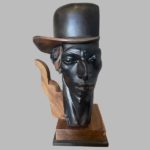
《年轻犹太人肖像(自雕像)》。1916年。纳坦·阿尔特曼。石膏。尺寸:51×31×27厘米。触觉模型。塑料材质,金属化处理(仿铜),木质基座。 作品呈现戴帽青年男子的面部造型。帽檐优雅弯曲且以截断形式表现,面部轮廓修长,五官鲜明,颧骨高耸锐利。棱角分明的塑造手法强化了光影的戏剧性效果:紧蹙的额头上,两道弓形浓眉聚向鼻梁,形成纵向皱纹;眼距开阔的杏仁状双眼微微凸起,鼻梁高挺带驼峰,双唇饱满,下颌线条刚毅。右耳被浓密的卷曲鬓发遮盖,强健修长的脖颈如同支撑这座杰出头雕的基座。雕塑固定于木质底座,通过金属压条与螺丝紧固,颈部右侧衔接有一个抽象木质构件。 1916年,阿尔特曼创作了这座著名的雕塑自画像——这件创新之作非凡地融合了青铜、铜与木材等多种材质。艺术家塑造了一位具有东方异域风情的俊美男子形象,面部特征强烈而富有表现力。在这件自画像中,阿尔特曼精湛融合了多种技术手段:拼贴技法、视角错位与概括形态的轮廓锐化,所有这些都服务于塑造凝练造型形象的创作目标。 纳坦·阿尔特曼(1889–1970)是戏剧艺术家、肖像画家、书籍插画家与雕塑家。出身贫寒犹太家庭,曾就读于敖德萨艺术学校,后赴巴黎深造,在那里结识了许多与他同样充满活力的艺术实验者。阿尔特曼深受现代主义影响,先后沉醉于印象派魅力,后又痴迷立体主义。凭借独立精神与坚定意志,他迅速成为当时最受瞩目的艺术家之一,在绘画、版画与雕塑领域均展现出独特而自由的创作力。其作品常蕴含民族主题(如《老犹太人肖像》、《犹太小镇》、《犹太纹饰》等)。传统与现代性在阿尔特曼的作品中达成和谐平衡,他不仅精通多种材料的处理技艺,更拥有独树一帜的造型视觉语言。