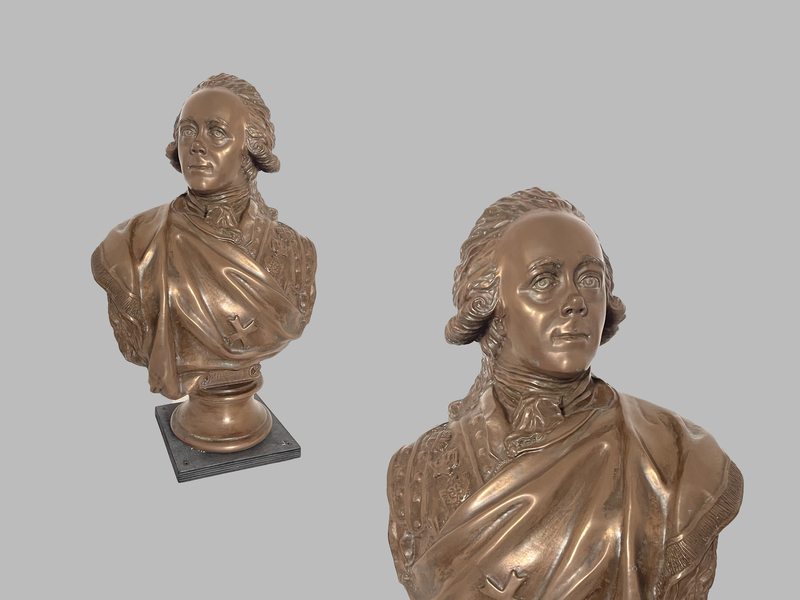
«Paul I». 1798. Fedot Shubin. Bronze. Dimensions: 74×47×33 cm.
Tactile model. Plastic, metallization (bronze).
A formal portrait of the emperor. His head is raised and turned to the right. He wears a wig with curls covering the ears, while a braid is loosened at the back, with wavy locks resting freely along his shoulders. The forehead is clear and very high. Thick eyebrows are raised. The eyes are large, slightly protruding, and gaze directly at the viewer. The nose is short and sharply upturned. The small mouth is tightly closed. The chin is large and prominent. A thin scarf is wrapped several times around the neck, with its end emerging near the chin. The emperor is depicted in knightly armor, draped with a cloak that covers his chest. The end of the cloak hangs from his right shoulder, falling in deep folds. Around his neck, partially hidden by the cloak, is the Order of St. Anne, his favorite order since childhood, inherited from his father, Peter III. A golden chain descends from his left shoulder, composed of alternating images of double-headed eagles, coats of arms, St. Andrew’s Crosses, and medallions. On the left side of his chest, beneath the cloak, the Order of St. Andrew the First-Called is visible. This order was the highest honor of the Russian Empire, consisting of an eight-rayed silver star with diamonds and the order’s insignia—a diagonal cross bearing the figure of the crucified St. Andrew the First-Called. Below, attached to the cloak, is the Order of St. John of Jerusalem in the form of an eight-pointed Maltese Cross.
This work is one of the most extraordinary phenomena in 18th-century Russian art, in which the author managed to create a multifaceted and contradictory image of the autocrat. Skillfully utilizing the possibility of a circular view of the sculpture and breaking with unprecedented boldness all the canons of an idealized formal portrait, the master reveals the complexity and contradictions of one of the most tragic figures in Russian history. Interestingly, this brutally truthful portrait received official recognition. It contained no grotesque exaggerations and was distinguished by the splendor of its setting, very much to the emperor’s taste. When viewed frontally, the sculptural portrait of Paul I appears before the viewer with a proud turn of the head, a stern, authoritative expression, and a haughty gaze of intelligent eyes.
Part 2
The profile viewpoint reveals another facet of Paul I’s nature. A creatively gifted individual, he was passionate about literature, music, art, and architecture, and from childhood dreamed of reviving the traditions of medieval knighthood with its code of honor, nobility, and worship of the Beautiful Lady. An intent gaze, a slight smile, and soft, smooth lines of the silhouette speak of Paul’s character, encapsulated in a single line by Pushkin: «our romantic emperor.»
His long-awaited ascension to the Russian throne in 1796 was an event of exceptional importance for Paul I. Behind him were the years when the heavy emotional experiences of the tsarevich and his disagreement with the lifestyle and form of rule of his mother, Empress Catherine II, were masked by an appearance of complete submission to her will—years of impatient anticipation of the longed-for hour of vengeance for the murder of his father, Peter III. Henceforth, Paul I was the all-powerful autocrat, intending to put an end to the moral laxity of the Catherine era. Noble, well-mannered, and educated yet unstable, he aspired to be a strict and just monarch, never forgetting the knightly ideals of honor and morality. In 1798, at the request of the knights of the Order of Malta, striving to protect ancient spiritual values, Paul I became the Grand Master of this oldest knightly order.
by Vitaliy Vertogradov