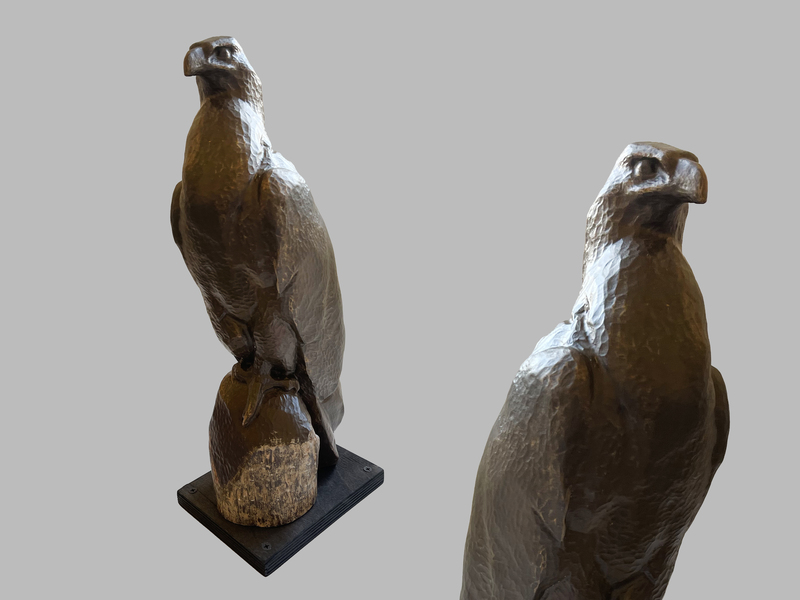
«Eagle». 1927. Vasily Vatagin. Wood. Dimensions: 89×25×34 cm. Tactile model. Plastic.
A generalized sculptural depiction of an eagle. The bird of prey sits calmly on a flat-cut log, its head turned to the left. The head is held proudly, with a sharp, piercing gaze and a curved, pointed beak. The wings are tightly folded. Only one leg is visible.
Vasily Alexeyevich Vatagin (1883–1969) was an outstanding sculptor, painter, graphic artist (both easel and book illustration), educator, professor, and academician. Vatagin was also a renowned zoologist and one of the founders of the State Darwin Museum in Moscow. The artist dedicated his entire career to depicting animals, establishing himself as a leading Russian animalier (wildlife artist).
For his sculptures of animals and birds, Vatagin employed a wide range of materials: wood, marble, metal, majolica (a type of glazed ceramic), ivory, and glass, striving to explore each material’s unique sculptural potential.
His precise scientific knowledge of animal anatomy, movement, and behavior allowed Vatagin the artist to create expressive, memorable depictions of wildlife. He sought to capture the «psychological» essence of an animal, revealing its distinctive traits and crafting an original «portrait.»
At the time of this sculpture’s creation, Vatagin was fascinated by the mythology of the East and ancient Egypt, where fauna was often mystically deified. Across many cultures, the eagle symbolizes strength, pride, grandeur, and the sun—but also height, ascension, liberation from constraints, and courage. Studying this sculpture raises a question: «Can this eagle still take flight?» It appears captive, with one leg missing. What do you think?
by Sapiyat Abdurashidova