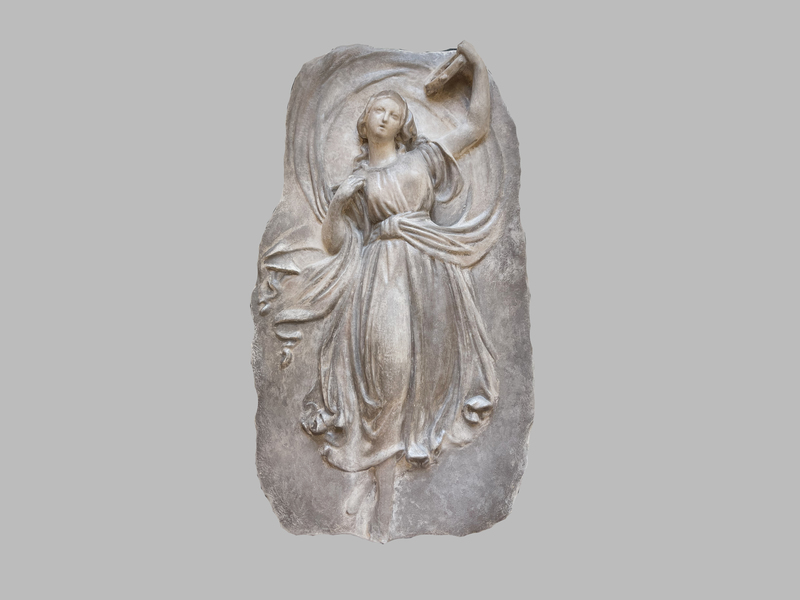
«Woman with a Tambourine. Allegory of Dance». 1820s. Unknown author. Plaster. Size: 83×50 cm. Tactile model. Plastic. On a rectangular slab with uneven edges is a relief image of a dancing woman. Her head is slightly tilted to the left, she is wearing a scarf, from under which wavy strands of hair are sticking out. The dancer’s face has perfect classical features and a spiritual expression, her gaze is turned upward. She seems to hear the music accompanying the beautiful dance. Her left hand is raised and slightly bent at the elbow, in it the girl holds a tambourine, her right hand touches her shoulder. The figure is gracefully curved and wrapped in numerous folds of a dress reminiscent of an antique chiton. They emphasize the rapid nature of the movement. The belt of the dress, transformed into a flying scarf, is thrown up and forms a round loop above the dancing woman’s head. The girl gracefully steps with one leg, the other leg is bent and hidden in the folds of her clothes. A sculptural relief is a type of sculpture that is a convex image located on a background plane. The use of a plane as a background distinguishes relief from round sculpture, so relief is designed only for frontal perception.
Each of the reliefs has two names — a specific one («Woman with a Tambourine» and «Woman with a Lyre») and an allegorical one. Allegory is translated from Greek as «allegory». Allegory is understood as an artistic representation of ideas or abstract concepts through a specific image. That is, a phenomenon or concept is not named directly, but is depicted allegorically using other images or words. (For example, an allegorical symbol of medicine is a snake wrapped around a cup on a high leg). Allegory as an artistic device was widely used in the art of the 18th and 19th centuries. The decorative reliefs «Allegory of Dance» and «Allegory of Music» are an example of an allegorical depiction of such arts as Dance and Music. Both reliefs are approximately dated to the 20s of the 19th century, that is, they belong to the Classicism style. Classicism is characterized by an appeal to antiquity, a desire for ideal forms and a harmonious combination of details and the whole.
by David Boles
by Maria Kazakova