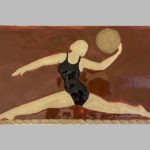
Sportswoman with a Ball «Sportswoman with a Ball». 1930. David Yakerson. Ceramic, enamel. Dimensions: 23×39 cm. Tactile model. Plastic. A rectangular sculptural relief. Against a dark red, streaked background stands the figure of a young sportswoman in a black athletic swimsuit, captured mid-throw. She has fair hair cut in a bob. Her expression is calm and focused. The girl’s head is tilted toward her left hand, which holds the ball, while her right arm is extended widely to the right. Her torso is shown frontally, but her legs are turned, twisting her body like a coiled spring — a pose imbued with great expressiveness. The stance is dynamic, depicting an extraordinarily wide leap, almost a split. A sculptural relief (from the Italian for «protrusion, convexity, elevation») is a type of sculpture featuring a raised image set against a flat background. In this case, you see a bas-relief, where the projection from the background does not exceed half the volume. The use of a flat background distinguishes relief from freestanding sculpture, which occupies full three-dimensional space. This decorative relief by David Yakerson (1896–1947) is dedicated to the theme of sports and dates to the 1930s. This was a period when, in the new Soviet state, official ideology actively promoted mass physical culture and sports. The prevailing idea was the creation of an ideal future human — the new Soviet person — through universal physical improvement. Art was called upon to serve this vision. Hence, the subject of this work — an athletic sportswoman with a ball — embodies the strength and power of a physically developed, exemplary new human being. In conclusion, it is worth noting that such an approach is characteristic of the aesthetic of the ORS masters (Society of Russian Sculptors), who consistently sought energetic, expressive forms for contemporary themes. The new understanding of the individual and their role in society found reflection in art primarily through materiality itself — including the choice of sculptural means and representational techniques. by Daniil Dolgikh