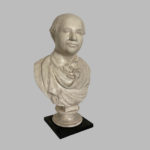
«Portrait of the Scientist M.V. Lomonosov». 1793. Fedot Shubin. Plaster. Dimensions: 73.5×46.5×29 cm. Tactile model. Plastic. This intimate portrait is recognized as one of Fedot Shubin’s finest sculptural works, distinguished by its realism and multifaceted characterization. Lomonosov is depicted without a wig, his head slightly raised, with a spiritual and contemplative expression. He has a prominent, domed forehead. Short curly hair lightly covers his ears, temples, and neck. Thick eyebrows are raised in a look of surprise, and his gaze is directed to the right and slightly upward, as if the scientist is observing an object that has fully captured his attention. The nose is large and straight, the cheeks are full. A subtle smile plays on his lips, with the lower lip slightly protruding. The chin is strong and well-defined. Mikhail Vasilyevich is dressed in a simple shirt with a turn-down collar and a modest jabot—a type of frilled neckwear. A cloak is draped over his shoulders, thrown over the left shoulder and resting on the right, forming deep, sharply defined folds across the chest. The cloak resembles the garments of great figures of antiquity. When viewed in profile, the sculpture reveals a different dimension of the subject: the dreamy, lyrical expression gives way to strength and dignity. The portrait captures a man who is perceptive, focused, courageous, strong-willed, yet also modest, unpretentious, and good-natured—qualities admired by the great scientist’s contemporaries. Mikhail Vasilyevich Lomonosov was a renowned Russian scientist, polymath, artist, poet, and writer of the 18th century. During the rise of Classicism in the second half of the 18th century in Russia, key societal ideals emerged: the possibility of constructing an ideal state, harmonious relations between humanity and nature, patriotism, civic duty, the creation of a «new fatherland,» and the intrinsic value of the individual beyond social class. Artists and sculptors drew inspiration from classical antiquity, as known through literary, sculptural, and architectural monuments. Antiquity was perceived as an era of free personal development and human spiritual and physical perfection. In Russia, sculptors of this period primarily depicted heroes of the ancient world. However, Fedot Ivanovich Shubin chose his own path. He was drawn to the possibility of revealing individual character through sculpture and left behind a remarkable portrait gallery of his contemporaries. Shubin focused on busts, paying close attention to the faces of his subjects while treating clothing with less emphasis. To fully appreciate the person depicted, each work must be viewed from two angles: frontally and in profile. by Irina Savenko