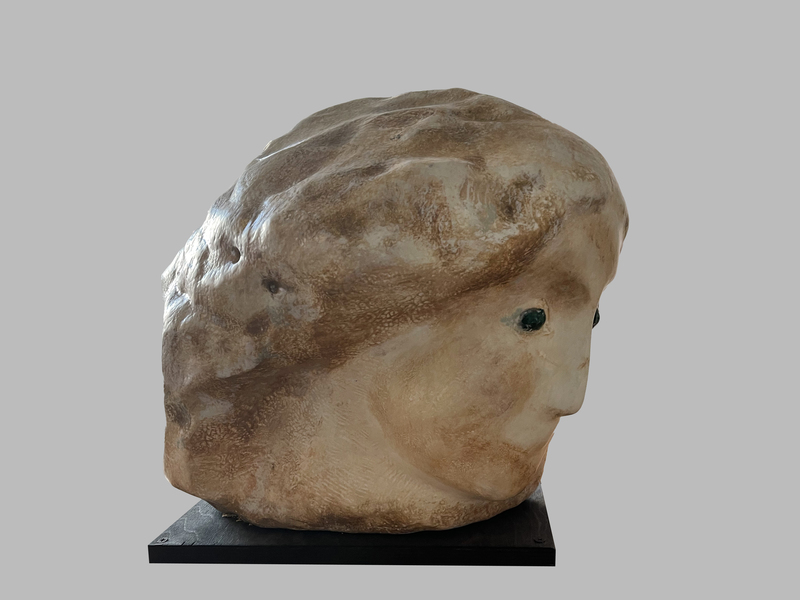
«Kore». 1912. Sergei Konenkov. Marble. Dimensions: 30.5×24×35 cm. Tactile model. Plastic.
The sculpture depicts a young woman’s head, imitating the color and texture of light beige painted marble. The head closely resembles those of ancient Greek statues found in art museums worldwide. It is slightly tilted forward, as if the figure were meant to portray a swimming maiden or one walking against a strong wind. The hair framing the face on all sides retains the rough texture of untreated stone, while the face is finely polished. Widely spaced, convex eyes with round pupils are painted bright green. The nose is straight and slender, and the mouth is only faintly defined, its form reminiscent of an archaic smile. The lower part of the face is intentionally unfinished, revealing the natural, unworked texture of the stone. This artistic choice evokes the elemental force embodied by the goddess, while also giving her the appearance of an archaeological artifact.
The sculpture «Kore,» blending portraiture with abstract allegory, was created by Sergei Konenkov in 1912 during his period of fascination with ancient Greek art.
Sergei Timofeevich Konenkov (1874–1971) was often called the «Russian Rodin.» In his work, the sculptor sought to move beyond the naturalism and academicism of the 19th century. His innovative tendencies led him to explore Greek archaic art and folk traditions, as well as to prefer solid sculptural materials such as marble and wood over traditional clay. Konenkov achieved great success as a master portraitist, with his most representative works often drawing on fairy-tale and mythological themes.
In ancient Greek mythology, Kore—meaning «maiden»—was one of the names of the goddess Persephone, the deity of agricultural fertility. This explains the choice of material (marble), the polychrome or multi-colored painting (reflecting the known Greek practice of painting sculptures), and the combination of a generalized, scarcely individualized treatment of the young woman’s facial features.
by Irina Savenko