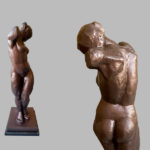
«Julia». 1925. Vera Mukhina. Tinted plaster. Dimensions: 180x54x53 cm. Tactile model. Plastic. A figure of a standing nude woman. The body is rendered somewhat conventionally, with a heavy, monumental quality, in a Cubist manner. The arms are absent. The head is turned to the left and downward. The torso is sharply twisted to the left, following the movement of the head, as if the woman is looking back. The hips and legs are large, with hypertrophied, emphasized muscles. The left leg is bent at the knee. The name of Vera Ignatyevna Mukhina (1889–1953) was a household name during the Soviet era and was considered the standard of Socialist Realism. However, the master’s path to fame was far from simple. Vera Mukhina was born in Riga into the family of a successful merchant from an old merchant lineage. She lived in Feodosia and then in Kursk. In 1909, she moved to Moscow, where she began studying painting. She studied in Paris. She traveled throughout France and Italy, where she studied monuments of classical art. Immediately after the start of the First World War, Mukhina completed courses for nurses and worked in military hospitals until the middle of 1918. Throughout this period, she did not abandon her artistic pursuits. After the October Revolution, Mukhina actively participated in the implementation of the monumental propaganda plan. In the 1920s, she worked on exhibition design, magazine graphics, and posters. From the second half of the 1920s, Mukhina engaged in teaching. Her early works show the sculptor’s path towards a strategy of openly using new visual means – a «new physicality» in easel works and gigantomania in the monumental sculpture of the 1930s. This new physicality was intended to form the image of a person of the new world – strong and beautiful. The boldness of Mukhina’s discoveries, especially in the use of new materials such as glass and stainless steel, and the radical nature of many of her plastic solutions, set a vector moving forward, towards the future. The heroes of Mukhina’s works – whether monumental monuments or easel sculptures, specific characters or typological images – are, first and foremost, those who purposefully create, passionately struggle, and inspirationally conquer the natural elements and the peaks of scientific thought. The title of the work is connected with the name of the ballerina Podgurskaya, who served as the model for the author’s complex artistic concept. However, the refined grace of the ballerina yielded in this work to the sturdiness of consciously weighted forms, which allowed for the birth of an image of a beautiful woman, a kind of standard of a healthy, energetic, and harmoniously built body. Despite its small size, the sculpture possesses a monumental appearance. by Irina Savenko