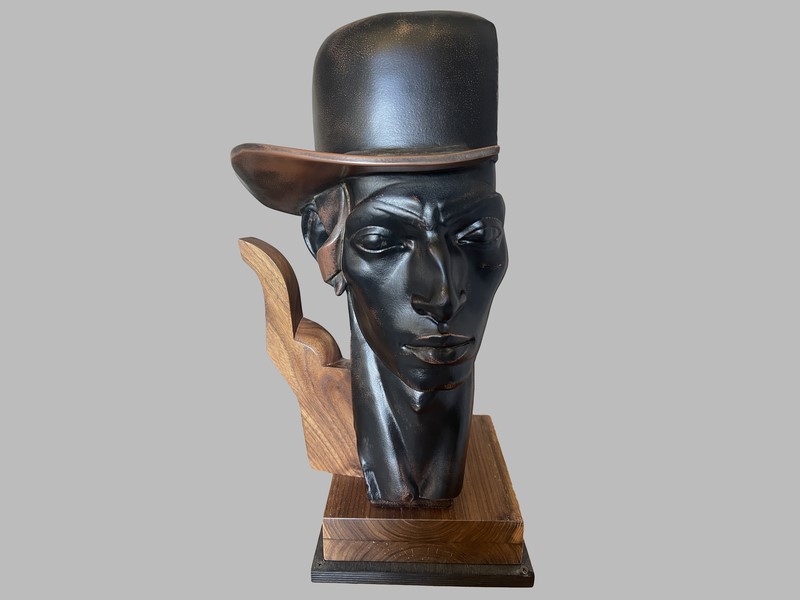
Portrait of a young Jew (Self-portrait). 1916. Nathan Altman. Gypsum. Size: 51x31x27 cm. Tactile model. Plastic, metallization (copper), wood.
The facial part of a young man’s head wearing a hat. The hat, with elegantly curved brim, is shown in a truncated form. The face is elongated, with strong features and high, sharp cheekbones, seemingly sculpted in facets that emphasise an expressive play of light and shadow. On the tense forehead, broad, arching eyebrows converge towards the bridge of the nose, where vertical wrinkles are visible. The widely set, convex almond-shaped eyes, a large nose with a pronounced bridge, full lips, and a resolute chin complete the striking visage. Only the right ear is visible, partially concealed by a tightly curled peyos (sidecurl). The powerful, slender neck serves as a pedestal for this magnificent head. The sculpture stands on a wooden base, secured to it by screws with a metal strip. To the right of the neck, an abstract wooden figure adjoins it.
In 1916, Altman created his famous sculptural self-portrait—a groundbreaking work that employed an unusual combination of materials: bronze, copper, and wood. It depicts a handsome man of an exotic Eastern type, with strong, expressive facial features. In this self-portrait, Altman masterfully blends diverse techniques: collage, shifting perspectives, and sharpened contours of a generalised form—all serving the goal of embodying a rich, sculptural image. Nathan Altman (1889–1970) was a theatre artist, portraitist, book illustrator, and sculptor. Born into a poor Jewish family, he studied at the Odessa Art School before continuing his education in Paris, where he encountered like-minded experimental artists. Fascinated by modernism, Altman was initially captivated by Impressionism before embracing Cubism. Independent and determined, he quickly became one of the most notable artists of his time, working with originality and freedom in painting, graphics, and sculpture. His works often explored Jewish themes (*Portrait of an Old Jew*, *Shtetl*, *Jewish Graphics*). Tradition and modernity harmoniously coexisted in Altman’s art. He excelled in techniques involving diverse materials and possessed a uniquely innovative sculptural vision.
(Note: «Peyos» (Yiddish) refers to the sidelocks traditionally worn by some Jewish men. The term is retained for cultural specificity.)
by Sofya Larina